Maria Duhova Trevor
Welcome to my web site. This site is designed to help you get to know me and my harps, and become better acquainted with the world of harp music. I do hope you will choose beautiful harp music for your wedding or other special event. I live in Columbia, Missouri and I am also available to perform in the Saint Louis and Kansas City area. Because I get booked quite far in advance, please contact me to reserve your opportunity as soon as you are able.
Maria
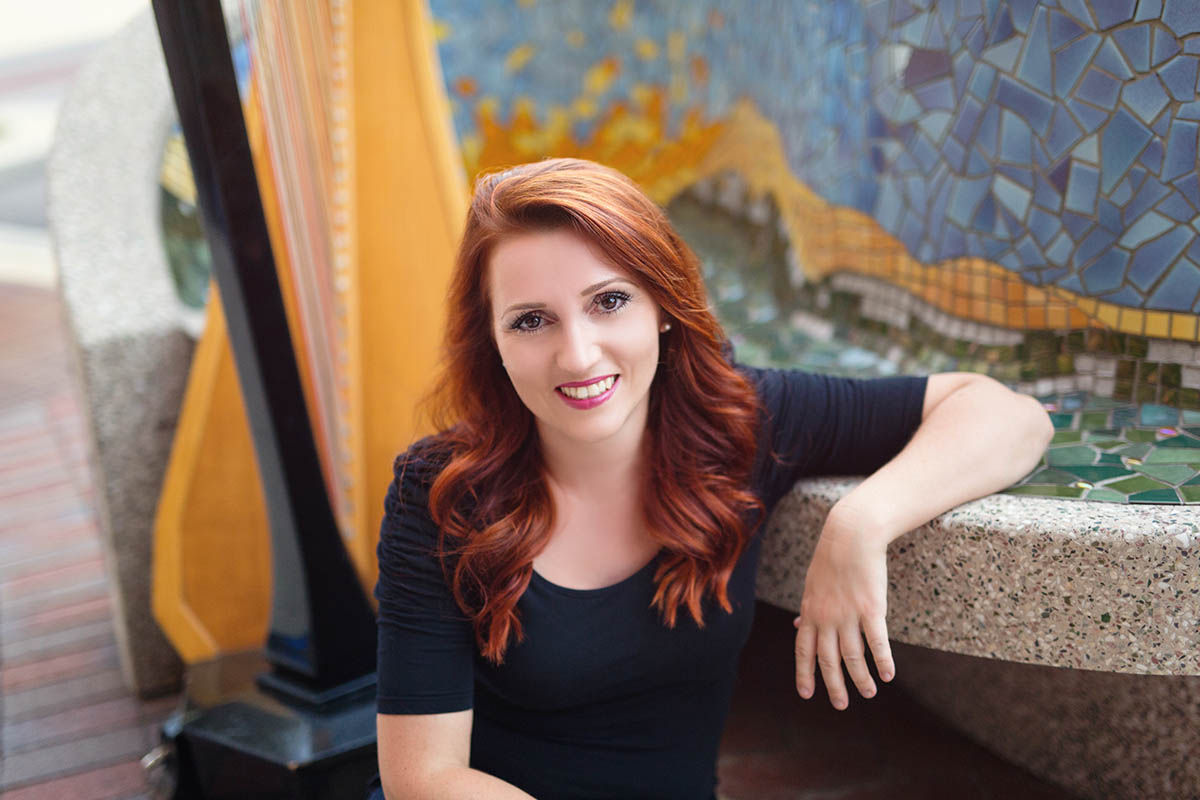
Born in the Slovak Republic, Maria Duhova Trevor holds a Masters degree in harp performance from the Academy of Music and Dramatic Arts in Bratislava, where she studied under Katarina Turnerova and Adriana Antalova. Prior to that she studied harp performance in Conservatory in Zilina under Tibor Kovac, graduating with the performance of Mozart’s Flute and harp concerto with the Slovak Sinfonietta. During her Conservatory studies she made a recording of several solo harp pieces for the Slovak Radio.
From 1996 until 1999 Maria was principal harpist of the Bohuslav Martinu Philharmonic in the Czech Republic with whom she toured extensively.
In 1999, Maria was a featured recitalist at the Seventh World Harp Congress in Prague. That same year she won the harp position at the Slovak National Opera, where she participated in over thirty opera productions, and fifteen ballet productions and with whom she went on tour throughout Europe.
In 2001 she premiered and recorded a new work by David Ott for harp and orchestra “The Angel’s Harp”. Between 2002 and 2005 Ms.Duhova was affiliated with the Slovak Radio Symphony Orchestra with whom she participated in dozens of contemporary music recordings for Naxos, EMI, Albany Records, and others as well as numerous movie and TV scores. In 2003, she joined the Radio Symphony Orchestra on their tour to Japan.
Between 2002 and 2005 Maria was affiliated with the famed Slovak Radio orchestra. She made numerous recordings of contemporary works for Naxos, Albany, EMI and others. She also performed in numerous film score recordings for Hollywood and TV. In 2003 she joined the orchestra in their ten concert tour of Japan.
Since 2001, Maria has performed in the Missouri Symphony Orchestra’s two month-long “Hot Summer Nights” Festival as principal harpist and also works as librarian. She has been featured as a soloist with the orchestra in the Ravel Introduction and Allegro in 2002 and the Mozart Flute and Harp Concerto in 2004.
Maria has lived in Columbia, Missouri since 2006 with her husband, conductor Kirk Trevor and their two young children Sylvia and Daniel. She plays solo and chamber music, and teaches privately in the region. She also collaborates with local musicians and appears regularly with Columbia Civic Orchestra, University Philharmonic Orchestra and Symphonic Wind Ensamble.
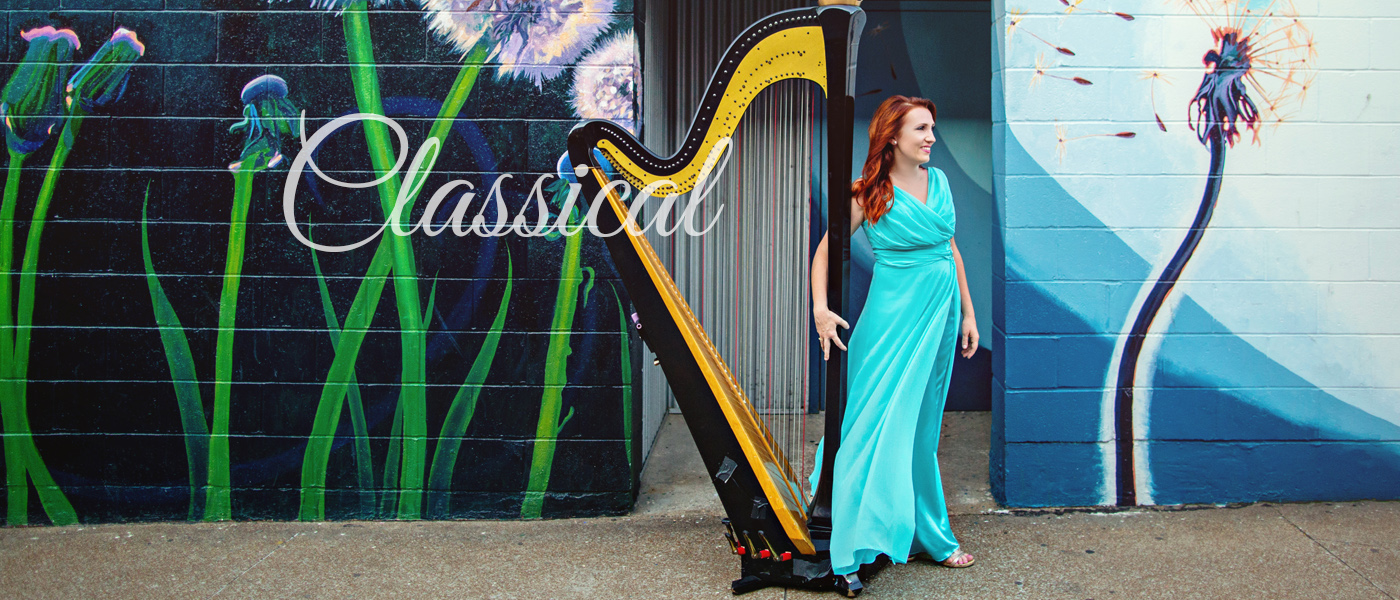
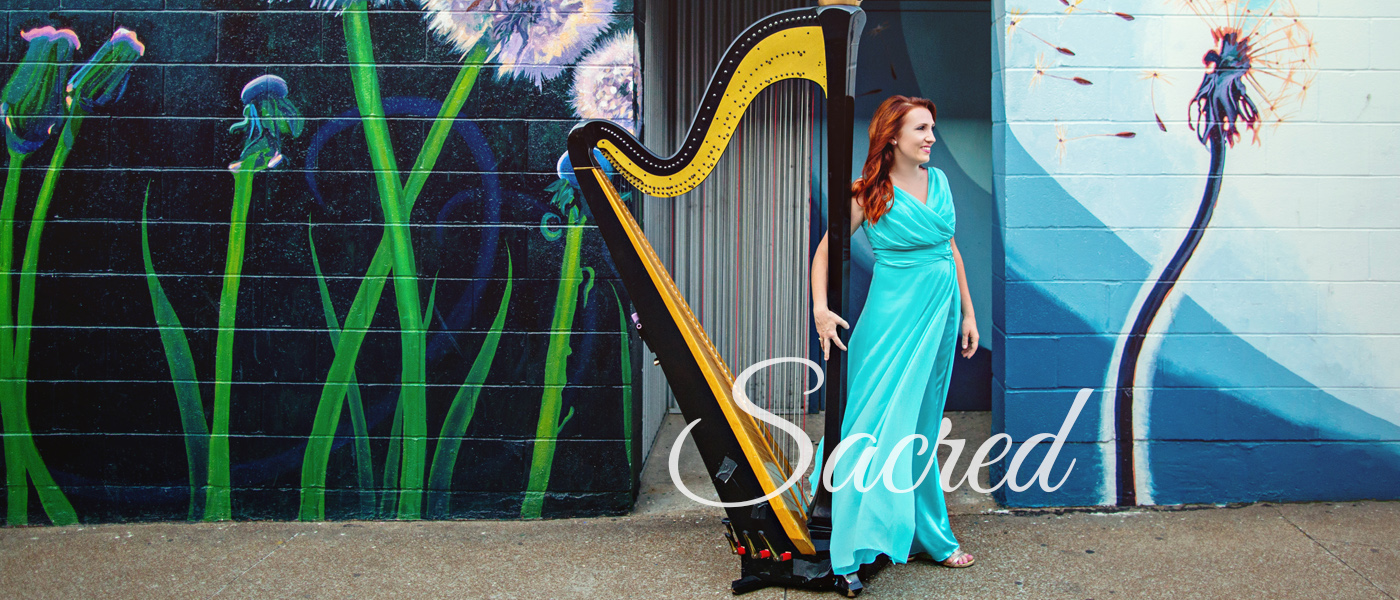
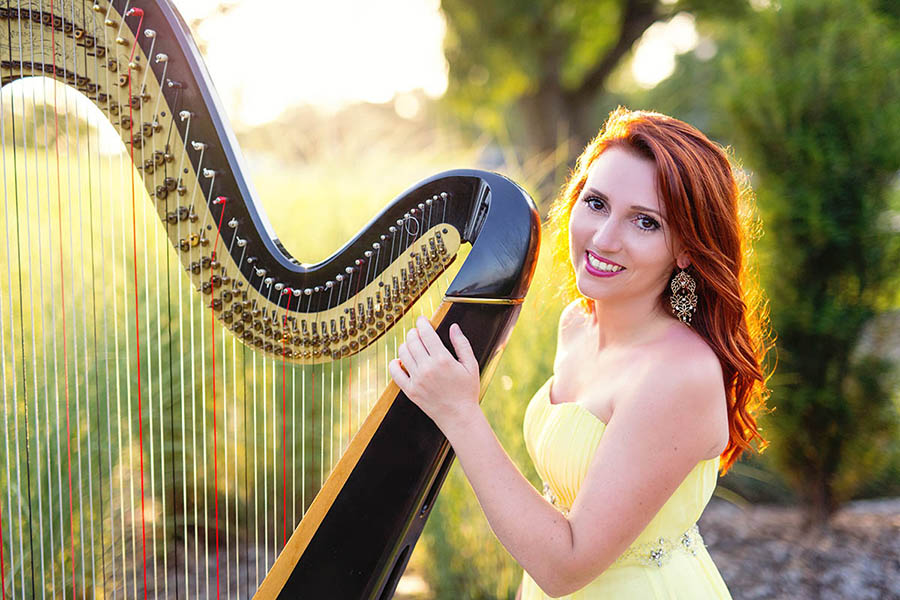
Maria plays Lyon and Healy Style 30 Concert Grand Harp
Congratulations on your upcoming wedding! I always feel very honored when a couple asks me to be part of their wedding ceremony and I do my best to recognize and fulfill their musical needs.
As part of my Wedding package I provide you with a consultation session at my studio, where you can listen to me play live music samples and make your music selection. We will also discuss other details necessary to make sure that everything will be perfect.
Wedding package
1 consultation session
Playing all of the following or just your selection:
Prelude ( 20 minutes )
Continued...
Processionals:
Music for special moments during the ceremony such as:
Recessional music
Postlude ( 10 minutes )
Continued...
Please contact me to check my availability for your personalized price quote.
Listen to music samples from my wedding music repertoire:
For more music samples, please click here for solo harp repertoire and here for flute and harp repertoire.
In today’s fast world we sometimes would like to slow down and enjoy the moment. I believe that live music offers us that opportunity and more. Not only you can stop time and enjoy what you are hearing, you can even go back in time, decades or even centuries, depending on your musical taste and selection.
Beautiful harp music can bring a special touch to any event. I am often asked to perform at the following types of function.
CORPORATE EVENTS:
PRIVATE EVENTS:
Here are some music samples:
Continued...
Please click here to contact me for a personalized price quote and to check my availability.
CHRISTMAS MUSIC also available during the Holiday Season.
Listen to music samples:
Please click here to contact me for a personalized price quote and to check my availability.
One of the ultimate chamber music combinations. Since 4000 BC we can see our predecessors playing these instruments on the ancient Egyptian papyruses. Later on, the melting sound of the flute accompanied by harp inspired composers such as Mozart, Debussy and Ravel to write concertos and chamber music for these instruments.
I perform with a wonderful flute player Brooksie Collins. We are available to play for weddings, concerts or any special events.
Listen to music samples
Continued...
Continued...
Introducing my friend and chamber music collegue, Brooksie Collins:
Brooksie was born in Columbia, MO. She was a four year member of the Missouri All-State band, finishing as first chair in 1996. She was featured with Hickman High School playing Bourne’s Carmen Fantasie for her senior solo. Also in 1996, she was selected as first chair in the John Phillip Sousa National Band, as well as third chair in the Music Educators National Conference National Orchestra. She then began attending the University of Missouri-Columbia in 1996, earning her Bachelor of Science in Music Education, graduating Magna Cum Laude in 2001. In 1997, she won the Missouri Music Teachers Collegiate Woodwind Solo Competition.
Mrs. Collins performed throughout the United States with the Buder Woodwind Quintet , as well as winning the state, regional, and sectional runner up for of the Music Teachers’ National Association in Chamber Music Competition.
In 2000, she was principle flute for MU’s Symphonic Wind Ensemble’s Australian tour which culminated in a performance in the Sydney Opera house. In 2000, Mrs. Collins was also selected as second chair flute in the Missouri All-Collegiate Band. She was the conductor for the Mexico, Missouri Community band, and a performer in the Troy, Missouri and Columbia Community bands. She was a featured soloist with the Columbia Community band in 2008, performing the Chaminade Concertino.
Mrs. Collins currently resides in Columbia, MO where she conducts sixth and seventh grade bands at Smithton Middle School as well as teaching small group flute lessons. She also plans to graduate with her Masters Degree in Music Education from the University of Missouri- Columbia during the summer of 2009.
It gives me great pleasure to teach harp and see my students make progress. I am very proud to see them play well and enjoy themselves at the same time.
I teach adults and children, both with and without previous musical experience. I teach both pedal and lever harps.
The lessons are held either at my studio or at my student's homes if they play pedal or larger lever harp, as they are not as easily transported.
Most lessons are one hour long, some students prefer one and half hour lessons. Half hour lessons are not advisable unless the student is a young child with a short attention span.
In my teaching I put a big emphasis on a good quality round warm sound, which can be established by correct hand position.
In both adults and children I reinforce the need of solid technique which we achieve by playing scales, arpeggios and studies.
How many strings does a harp have?
Depends on the size of the harp. Pedal concert grand harp has 47 strings, there are pedal harps starting at 40 strings, lever harps usually have 34 or 36 strings, folk harps 22.
What is the difference between lever and pedal harp?
Pedal harp has pedals to create half steps and the lever harp has levers to do the same thing. Lever harps are limited in the number of keys they can play in. Imagine that the harp strings are like white keys on the piano. If we want to create “a black key” up or down a half step, we have to do it by pushing one of the seven pedals up or down on the pedal harp or pushing the desired lever down on the lever harp.
Why are there 7 pedals on the pedal harp?
Seven pedals represent the seven tones in a scale. They are placed at the base of the harp on the left they are D C B and on the right E F G A. Pedals serve to flatten or sharpen the desirable note. There is a mechanism attached to each pedal that goes all the way through the column to each string. It ends with a set of two discs on each string. These discs tighten the string – make it a half step higher. Each pedal can be put in three positions – 1. flat ( when the string is released from the discs ), 2. natural ( one discs grips the string ) 3. sharp ( both discs grip the string) Each pedal operates on all the same note strings on the harp, meaning if you push the C pedal to the sharp position, all C stings on the pedal harp become C sharp.
What are the strings made of?
Harp strings are wire, gut and nylon. Bottom – low strings are wire, followed by the rest of the harp strung in either gut or nylon.
Why are some strings red and some blue?
They are colored for better orientation for the harpist. Every C is red and every F is blue. It would be very hard to find the right notes on the harp without this little help.
How much does the harp costs?
Lever harps start around $ 2,500, pedal harps around $ 15,000 and go up to $ 50,000!
Are older harps better than new ones?
Not really. Because of the complicated pedal mechanism, harps age just like pianos, and unlike violins, don’t increase in value with age. Aged wood might sound better, but the mechanics become unreliable. A one hundred-year-old old instrument is more of a collectible rather than a performance instrument.
How strong is the harp sound, do I need to amplify it during the wedding ceremony outdoors?
The concert harp has a stronger sound than most people think. However sound doesn’t carry well outdoors, so it is advisable to amplify the harp.
Does weather and humidity influence the harp much?
Yes, since harp is made of wood and strings are made of gut, both these materials react to weather and humidity. Strings contract under cold conditions (they sound higher ) and expand in warm weather ( lower). So it is hard to keep the harp in tune in changing weather conditions or outdoors.
Do you travel with your harp? How do you transport it?
I transport my harp all the time. It took me some time to find the right car, but eventually I found a Chrysler Pacifica, which has back seats that fold flat and I’m able to just slide my harp in there without having to take any seats out.
Do you need help transporting, loading and unloading your harp?
When performing I always appreciate helping hands getting the harp, stand, bench, music etc. out of the car.
Do I need to own a harp to start lessons?
You will need a harp to practice on. If you don’t want to purchase right away, I own several lever harps that I rent to new students for 6 months trial period. In case they are all out, I can navigate you to Rent to Own programs offered by different harp makers.
How much do I need to practice?
Depends on many factors like, how much time you have, how many other interests you pursue, how time demanding your job is etc. However it is advisable to practice daily anywhere between half hour and three hours to make progress.
How often do I need to change strings on my harp?
Depends on how much you practice and perform. Professional harpists change the entire set of strings every year and also have the harp regulated yearly.
For students doing this, once every two or three years should be enough. Of course you always have to change the odd string that breaks in between – make sure you always have a spare set on hand.